Table of Contents
Categories

KOLISTI Team

Why Surface Material Decisions Directly Impact Pickleball Brand Reputation
User expectations for play quality in commercial courts
Players walking into a commercial pickleball venue expect a court that feels “right” underfoot and behaves predictably under the ball. They may not know the chemistry of the surface, but they instantly recognize whether the bounce is true and the traction feels secure. In commercial settings, surface performance becomes part of the overall customer experience, just like lighting, nets, and layout. If the court feels inconsistent, the venue’s professionalism is questioned before a single word is spoken.
How surface failures damage long-term brand trust
When a surface starts curling, shifting, fading, or becoming slippery, complaints follow quickly and publicly. Clubs and operators rarely blame the installer; they blame the brand that supplied the system. In today’s connected world, one poor-performing court can circulate through social media, forums, and word of mouth at alarming speed. Surface failure is not just a technical issue; it is a reputational liability.
Why procurement choices matter more than short-term savings
Many brands focus heavily on the initial price per square meter and overlook how that decision echoes for years. A cheaper surface that requires replacement, constant adjustment, or frequent maintenance quickly becomes more expensive than a reliable system. Procurement decisions in sports flooring are less about cost and more about risk management. The true metric is not price, but long-term operational stability.
Overview of Common Pickleball Court Surface Materials in the Market
Modular tiles, PVC mats, rubber rolls, and acrylic systems
The market is crowded with surface options, each promoted as a perfect solution. Modular plastic tiles are popular for their interlocking convenience, PVC mats for portability, rubber rolls for shock absorption, and acrylic systems for their professional court heritage. These materials were not all originally designed for pickleball, yet they have been adapted into the category. Understanding their origins helps brands evaluate their suitability.
Typical positioning and use cases for each material type
Modular tiles often appear in temporary outdoor setups and multi-sport areas where quick assembly is valued. PVC and rubber systems are used where cushioning is prioritized over ball response. Acrylic surfaces, long used in tennis and multi-sport courts, are positioned as performance-driven solutions. Each has a place, but not all align with the expectations of dedicated pickleball environments.
Strengths and weaknesses from a brand perspective
Tiles offer convenience but can create inconsistent bounce due to seams and panel flex. PVC and rubber provide comfort but may feel slow and muted during play. Acrylic surfaces deliver consistent response but require careful production and installation standards. From a brand perspective, the question is not which is easiest, but which delivers the most authentic pickleball experience.
Performance Factors Beyond Marketing Claims
Ball bounce consistency and surface responsiveness
Pickleball relies heavily on predictable ball behavior, especially during dinks and fast exchanges. Surfaces that absorb too much energy or create micro-variations in bounce disrupt the rhythm of play. Players notice this immediately, even if they cannot articulate the reason. A responsive, uniform surface becomes a silent ambassador for quality.
Traction, slip resistance, and player safety metrics
Proper traction prevents slips without feeling abrasive underfoot. Surfaces that are too smooth become hazardous, while overly textured materials cause fatigue and discomfort. The balance between grip and glide is a subtle engineering detail. Brands that ignore this balance risk both complaints and liability concerns.
Visual finish and professional court appearance
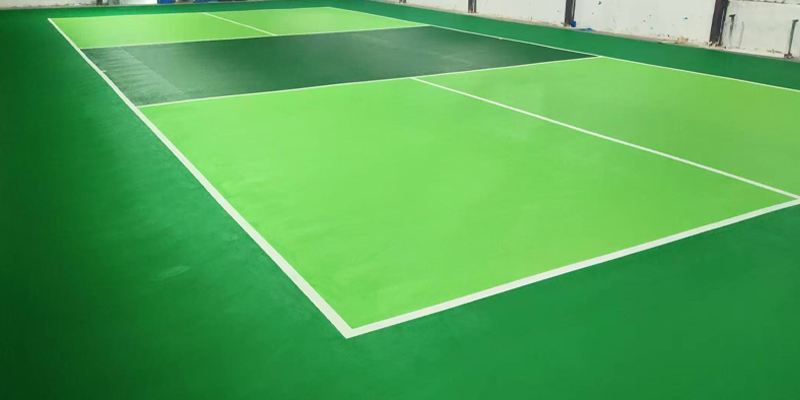
A court’s visual presentation influences how players perceive its quality before they even start playing. Uniform color, clean lines, and a professional finish elevate the perceived value of the venue. Surfaces that look patchy, segmented, or industrial detract from the experience. Aesthetic coherence supports brand positioning.
Durability and Lifecycle Cost Considerations
Wear resistance under daily play and event usage
Commercial courts endure thousands of footsteps and constant ball impact. Inferior materials show wear patterns quickly, especially in high-traffic zones near the kitchen and baselines. Wear resistance determines how long a court maintains its original performance. This directly affects how often surfaces must be repaired or replaced.
Maintenance frequency and operational burden
Some surfaces demand frequent realignment, cleaning, or part replacement. This creates operational headaches for venue managers and reflects poorly on the supplying brand. Low-maintenance surfaces free operators to focus on programming and customer engagement. Reduced upkeep is a hidden but powerful value driver.
Replacement risk and total project ROI impact
Replacing a surface is not just a material cost; it disrupts business operations and scheduling. Every replacement cycle chips away at the project’s return on investment. A durable surface extends the usable life of the court and stabilizes financial projections. Long lifecycle performance protects both the operator and the brand.
Installation Risk and Operational Practicality
Subfloor tolerance and installation complexity
Not all venues have perfectly prepared subfloors, especially in repurposed indoor spaces. Surfaces that require ideal conditions increase installation risk and rework. Systems that tolerate minor subfloor imperfections reduce complications. Practical installation is often overlooked during procurement.
Downtime, rework risk, and scheduling challenges
Complex installations extend downtime and may require specialized crews. If mistakes occur, the correction process can be lengthy and costly. Brands supplying easy-to-deploy systems reduce these risks significantly. Faster setup translates into faster revenue generation for clients.
Portability, storage, and repeat deployment needs
Many facilities require courts that can be removed and redeployed for events. Surfaces that roll, store, and redeploy without damage offer significant flexibility. This is especially valuable for indoor venues sharing space with other sports. Portability becomes a strategic advantage.
Quality Control and Manufacturing Consistency
Material formulation stability across batches
Inconsistent material formulation leads to variations in performance from one batch to another. This is particularly problematic for brands managing multi-location projects. Stability in formulation ensures predictable outcomes. Consistency builds trust over repeat orders.
Thickness control, surface uniformity, and curing standards
Minor variations in thickness affect bounce and feel. Proper curing ensures durability and resistance to wear. Factories with strict controls produce surfaces that behave uniformly across the entire court. Precision in manufacturing translates directly into performance reliability.
Inspection records, traceability, and supplier accountability
Professional suppliers maintain inspection records and batch traceability. This allows issues to be identified and resolved quickly if they arise. Brands benefit from working with partners who operate transparently. Accountability reduces long-term risk.
Why Roll-Out Acrylic Surfaces Are Increasingly Preferred for Pickleball
Factory-controlled production versus on-site variability
Roll-out acrylic surfaces are produced under controlled factory conditions rather than applied inconsistently on-site. This eliminates many variables that affect performance. The result is a court surface with predictable characteristics. Factory control enhances reliability.
Consistent performance for indoor, temporary, and multi-location courts
These surfaces perform consistently whether installed in a club, a gymnasium, or an event venue. They can be deployed temporarily or left in place long-term without performance degradation. This versatility is highly valued by growing pickleball operators. One system can serve multiple scenarios.
Reduced brand risk compared to modular surface systems
Without interlocking seams or shifting panels, roll-out acrylic surfaces provide a seamless playing area. This reduces bounce inconsistencies and maintenance issues. Brands supplying these systems face fewer complaints and service calls. The surface works quietly in the background, which is exactly what operators want.
Building a Surface Material Selection Framework That Protects Your Brand
Defining non-negotiable performance benchmarks
Brands should define clear performance criteria before selecting any surface material. Bounce consistency, traction, durability, and visual quality should be mandatory standards. These benchmarks prevent emotional or price-driven decisions. A structured framework leads to better outcomes.
Matching material choice to brand positioning and client type
Premium clubs, event organizers, and commercial facilities expect surfaces that reflect professionalism. Entry-level solutions may not align with their expectations. Selecting the right material supports the brand’s intended market position. Surface choice becomes part of the brand story.
Working with suppliers as long-term partners, not vendors
Reliable flooring suppliers contribute more than materials; they provide expertise and ongoing support. Long-term partnerships lead to better project outcomes and smoother repeat orders. Brands benefit from suppliers who understand pickleball’s specific performance needs. Collaboration, not transaction, is the key to sustainable growth.
Kindly visit below link to know pickleball court flooring cost guide.
Pickleball Court Flooring Cost (2026): Save 50% with Roll-Out Systems
Related Posts
How to Install Roll-Out Pickleball Court Flooring
Cushioned Pickleball Courts: Sourcing Guide for Global Brands
Outdoor Pickleball Court Flooring: 5 Sourcing Tips