 Skip to content
Table of Contents
Categories

Charles Wong
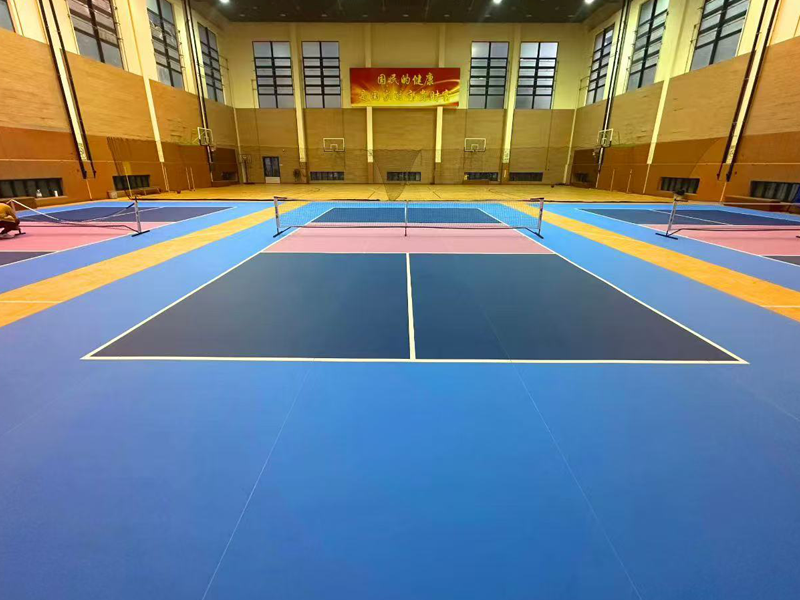
The reality of indoor pickleball court projects today
Common delays caused by traditional acrylic court construction
Traditional acrylic court construction indoors often turns into a slow, multi-stage ordeal that feels more like a renovation project than a sports upgrade. Each layer requires drying time, environmental control, and meticulous sequencing, and one humid day can throw the entire schedule off track. Facility owners quickly realize that what looks simple on paper becomes a logistical marathon once rollers, coatings, and curing windows enter the picture.
Limitations of working on existing indoor concrete floors
Most indoor venues already have finished concrete slabs that were never designed with sports surfacing in mind. These floors may be polished, sealed, slightly uneven, or contaminated with old coatings that complicate adhesion for liquid acrylic systems. Attempting to convert such a surface into a traditional court often requires grinding, priming, and surface modification that disrupts the entire facility.
Why facility owners demand faster court readiness
Indoor spaces are revenue-generating assets, and every extra day of construction means lost bookings, idle staff, and delayed programming. Owners are not just asking for a court; they are asking how quickly they can start hosting leagues, lessons, and tournaments. The conversation shifts from material selection to operational urgency, where time becomes the dominant metric.
What fast deployment really means for indoor court surfaces
Definition of fast deployment in sports flooring projects
Fast deployment is not simply about installing quickly; it is about compressing the entire construction timeline into a predictable, low-risk operation. It removes dependence on weather, curing cycles, and complex site preparation. In practical terms, it means a court that can be laid down, aligned, and ready for play within an exceptionally short window.
Impact on project timelines, labor, and venue downtime
When installation shifts from wet application to modular placement, project timelines shrink dramatically and labor requirements become far more manageable. Fewer workers, fewer tools, and fewer stages translate into less disruption to the venue’s daily operations. The downtime that once stretched into weeks can now be measured in days or even hours.
Why speed of installation directly affects ROI
Return on investment is tightly coupled with how soon a court can start generating activity and income. A surface that allows immediate use accelerates payback periods and improves overall project viability. For procurement professionals, this becomes a persuasive argument when justifying budgets to stakeholders.
How roll-out acrylic systems change the installation model
From wet construction to dry installation methodology
Roll-out acrylic systems replace messy on-site coating with a pre-engineered surface that arrives ready to deploy. Instead of spreading liquids and waiting for them to cure, installers simply position, align, and secure the material. This dry methodology dramatically reduces uncertainty and simplifies the entire workflow.
Eliminating on-site curing, coating, and line painting stages
Because the surface is manufactured with texture, color, and line markings already integrated, multiple traditional stages disappear entirely. There is no waiting for paint to dry, no risk of inconsistent line quality, and no rework caused by surface imperfections. What used to be a layered process becomes a single streamlined step.
Reducing dependency on skilled local flooring contractors
Liquid acrylic courts often require experienced technicians familiar with sports coatings and precise application techniques. Roll-out systems, by contrast, can be installed by general contractors or facility staff with basic guidance. This reduces scheduling conflicts and lowers the barrier to project execution.
Compatibility with typical indoor concrete subfloors
Requirements for flatness, cleanliness, and moisture control
A reasonably flat, clean, and dry concrete surface is usually sufficient for roll-out installation. Minor imperfections that would complicate liquid coating applications become far less critical. The focus shifts to simple preparation rather than invasive floor treatment.
Direct installation over existing finished concrete surfaces
Roll-out acrylic courts can often be laid directly over finished concrete without grinding or chemical preparation. This preserves the original floor and avoids dust-heavy processes that disrupt indoor environments. The court becomes an overlay rather than a permanent alteration.
Minimizing surface preparation and site disruption
With minimal preparation required, facilities avoid noise, debris, and extended closures. Installation becomes a controlled, predictable task rather than a construction project. This is particularly valuable in multi-use venues that cannot afford prolonged shutdowns.
Performance expectations for a professional indoor pickleball surface
Consistent ball bounce and controlled traction
A professional indoor surface must deliver reliable ball response and predictable traction across the entire court. Pre-manufactured acrylic textures ensure uniformity that is difficult to achieve with hand-applied coatings. Players experience a consistent feel from baseline to kitchen line.
Cushioning effect and player comfort during long sessions
Roll-out systems often incorporate subtle resilience that reduces joint fatigue during extended play. This slight cushioning can make a noticeable difference for clubs hosting long sessions and frequent matches. Comfort becomes part of the performance equation.
Noise reduction advantages in enclosed indoor spaces
Indoor pickleball can be loud, and hard surfaces amplify the distinctive pop of the ball. Acrylic roll-out layers can dampen sound transmission compared to bare concrete. This contributes to a more pleasant environment for players and spectators alike.
Operational advantages for brands, clubs, and contractors
Faster project turnover for multi-court installations
When installing multiple courts, the time savings compound rapidly. What once required staggered phases can now be completed in a condensed timeframe. This allows venues to launch full programs without delay.
Easier logistics, storage, and transportation compared to liquid systems
Transporting rolls is far simpler than shipping pallets of coatings, primers, and tools. Storage is straightforward, and materials remain protected until needed. Logistics become predictable and efficient.
Simplified maintenance and future surface replacement
If a section wears out or needs updating, it can be replaced without redoing the entire floor. Maintenance becomes modular rather than procedural. This long-term flexibility is attractive to facility managers.
Scalability for brands managing multiple indoor venues
Standardized surface quality across different locations
Using the same roll-out system across venues ensures identical playing characteristics everywhere. Brand standards are easier to maintain without relying on different local contractors. Consistency strengthens reputation.
Repeatable installation process for global projects
A repeatable process means teams can follow the same method in different countries with minimal variation. Training becomes simpler, and results become more predictable. Global expansion benefits from this uniformity.
Flexible deployment for temporary or semi-permanent courts
Some venues require courts that can be removed or relocated. Roll-out systems accommodate this need without sacrificing performance. Flexibility becomes a built-in feature.
Why fast deployment is becoming the new standard for indoor pickleball courts
Growing demand for modular and prefabricated sports surfaces
Across the sports flooring industry, modular solutions are gaining traction due to efficiency and reliability. Pickleball is following the same trajectory as facilities look for smarter installation models. Prefabrication reduces risk and accelerates progress.
Changing expectations from procurement and facility managers
Procurement professionals now evaluate surfaces based on installation complexity as much as performance. They seek solutions that simplify projects rather than complicate them. Fast deployment aligns perfectly with these expectations.
Future trends in indoor pickleball court surface technology
Advancements in materials and manufacturing continue to improve durability, comfort, and ease of use. Roll-out acrylic technology represents a shift toward practical, deployment-focused design. The future of indoor courts is increasingly defined by how quickly they can be put into play.
Related Posts
Removable Sports Flooring to Reduce Total Cost
Roll Out Gym Flooring Buyers Trust for Fast Scaling

Indoor Pickleball Court Flooring That Cuts Landed Cost